Our Decarbonization Targets

In line with the Guidelines for Climate Target Setting for Banks developed by the United Nations Environment Programme Finance Initiative (UNEP FI), Garanti BBVA aims to align its loan portfolio with net zero climate scenarios by 2050. In 2021, Garanti BBVA, as the first bank in the Turkish banking sector to commit to phasing out coal, pledged to reduce its coal-related exposure to a minimum by 2030 and to fully exit by 2040 at the latest. In 2023, these commitments were taken a step further by announcing 2030 interim decarbonization targets for carbon-intensive sectors such as energy, automotive, iron and steel, and cement.
Garanti BBVA’s decarbonization targets for the energy, automotive, iron and steel, and cement sectors for 2030 have been developed in accordance with the internationally recognized PACTA (Paris Agreement Capital Transition Assessment) methodology. These targets are regularly reviewed and updated in parallel with improvements in data quality. These interim targets represent a significant step towards emission targets aligned with net zero by 2050.
The primary objectives of sectoral decarbonization targets in carbon-intensive sectors are to measure clients’ progress in their decarbonization pathways, to provide financial support for investments in new technologies and production methods, to fulfill its commitment to transparency regarding environmental and social performance disclosures, and to reduce transition risks within the loan portfolio by increasing exposure to clients aligned with decarbonization targets.
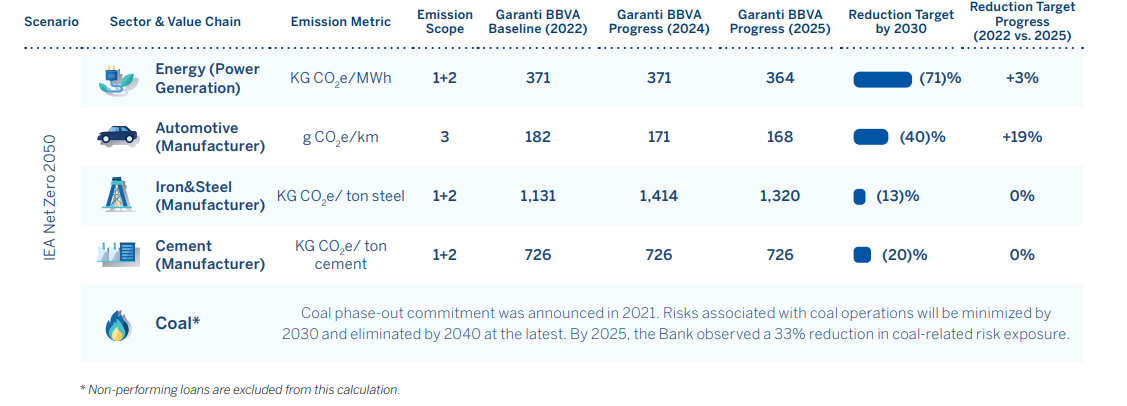
The progress in Garanti BBVA’s portfolio decarbonization targets for clients in the energy, automotive, iron and steel, cement, and coal sectors for 2025 compared to 2024 is as follows:
- Emission intensity in the automotive sector decreased by 2%, reaching 168 g CO2e/km.
- Due to limitations in the database used in calculations related to the cement sector, there was no change in emission intensity.
- In the iron and steel sector, emission intensity decreased by 7%, reaching 1,320 kg CO2e/ton of steel, due to the increase in short-term risk amounts in companies using Electric Arc Furnace technology.
- In the energy sector, emission intensity decreased by 2% due to the impact of the financing of renewable energy investments, reaching 364 kg CO2e/MWh.
- Risk exposure in coal clients decreased by 33%.
Garanti BBVA monitors emission intensity in sectors such as aviation, real estate, maritime, oil and gas, and aluminum, and is evaluating whether to announce new sectoral decarbonization targets in the future depending on the weighting of its loan portfolio in these sectors. On the other hand, independently of Garanti BBVA’s own declared targets, risks in all carbon-intensive sectors are also monitored within the scope of the decarbonization targets of its main shareholder, BBVA Group.
The Transition Risk Indicator (TRi) tool, developed by BBVA, enables the integration of the management of emission intensity reduction targets into daily risk management processes. Garanti BBVA utilizes the TRi (Transition Risk Indicator) to systematically assess climate-related transition risks within its credit processes and to evaluate its clients’ capacity to adapt to a low-carbon economy. The tool is defined as a structured mechanism that assesses clients’ level of awareness regarding climate change, their transition readiness, and the sustainability of their current business models.